


AI Fraud Agents: How AI Agents Speed Up Fraud Prevention and Create Business Value
Fraud systems usually detect well. What remains manual in many operations is everything that comes next: understanding why a rule creates friction, investigating a suspicious pattern, adjusting a strategy or preparing a report for leadership. Between detecting and responding there is an operational gap, and that is where many teams lose time.
GatekeeperX AI Fraud Agents are designed to narrow that gap. They are specialized artificial intelligence agents that work inside the risk decisioning system, alongside the human team: they analyze data, investigate context, suggest actions and help keep prevention strategies up to date. This article explains what each agent does, how they change a fraud team’s daily work and what value they can bring to the business.
What is an AI Fraud Agent?
An AI Fraud Agent is a specialized artificial intelligence agent that operates inside the fraud and risk decisioning system, alongside the human team. It interprets risk context, analyzes operational data, performs specific tasks and prepares actions in the platform, such as proposing a rule or registering the creation of a list.
The difference from a score or a dashboard lies in participation. A score indicates how risky an operation looks and a dashboard shows metrics. An agent helps with the questions that come next: why a rule blocks legitimate customers, which accounts are linked to the same device or which lists the team needs to update.
A hypothetical scenario: from problem to answer in one conversation
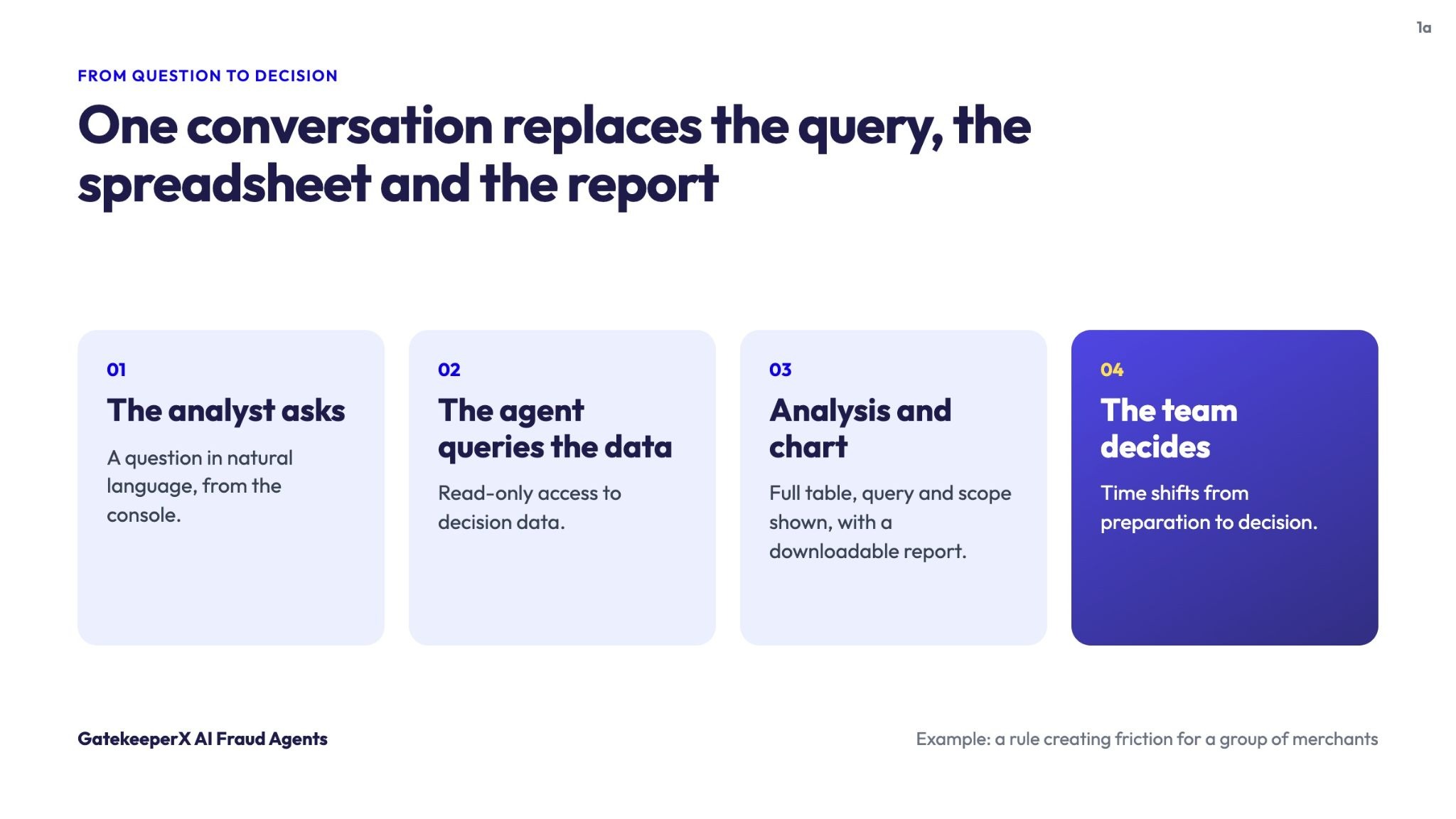
Imagine a fintech whose fraud team suspects that one of its rules is creating too much friction for a group of merchants. This is a hypothetical example to illustrate the concept; it does not describe a customer case.
- Without agents, the analyst requests a data query, waits for the result, moves it to a spreadsheet, builds the charts and writes the summary. Much of the effort goes into preparing the analysis rather than deciding what to do with it.
- With an AI Fraud Agent, the analyst asks the question in natural language from the console. The agent queries the decision data, identifies the rules that create the most friction, charts the results and lets the analyst download a report. It also shows the full table, the query it used and the scope of the analysis (period, event type and filters), so the analyst can validate the answer before acting.
If the analysis confirms the problem, the analyst can ask for an adjusted version of the rule. The agent builds it with the operation’s real fields and lists, warns if the rule does not discriminate or would fire on every event, and runs a simulation (backtest) before delivering it. The decision to take it to production remains with the team.
The change is not only about speed. The team’s time shifts from preparation work to decision.
How AI Fraud Agents help prevent fraud
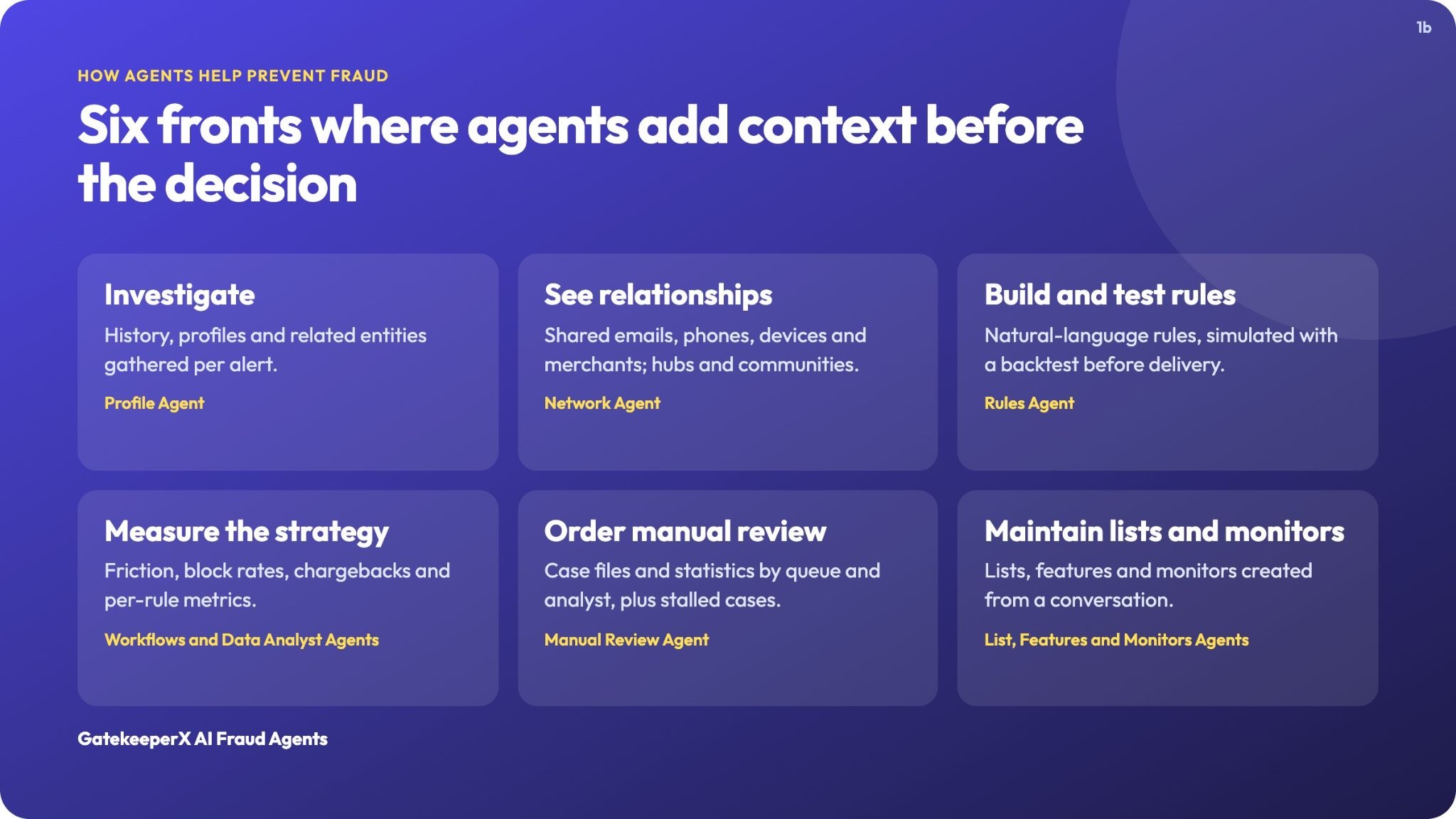
Prevention improves when the team has more context at the moment of decision and can test its changes before applying them. Agents provide both, on six fronts.
- They investigate with full context. The Profile Agent compares a transaction against the customer’s history and builds profiles of customers, merchants, payment methods, devices and movements or transfers, including the origin, the destination and the relationship between them. It also reports the engine’s decisions (approved, blocked or in review) and the risk signals. When an alert is generated, an agent can run automatically to analyze the context, investigate related entities, classify the alert and suggest an action.
- They see relationships, not just events. A transaction can look normal, and so can the account and the device. The pattern appears when they are connected. The Network Agent analyzes relationships starting from a customer, an email, a phone number or a merchant, and detects shared resources such as emails, phone numbers, devices or merchants. It identifies hubs, communities and centrality, and assesses risk based on the structure of connections and coordinated fraud.
- They build and test rules. The Rules Agent creates a rule from a natural-language description, or modifies an existing one. It builds the rule with the operation’s real features, fields and lists, validates its syntax, searches for similar rules and warns if a field is always 0, arrives empty or does not arrive at all. Before delivering the rule, it simulates it (backtest).
- They understand the strategy and measure its effect. The Workflows Agent lists workflows and their rules, explains the strategy of each one, compares versions over time, finds similar rules across workflows and detects rules that act as a control group. It calculates metrics per rule: events, amount in USD and share of the workflow. The Data Analyst Agent measures friction, block rates, chargebacks and rule precision.
- They bring order to manual review. The Manual Review Agent shows a case file with the full evaluation of the event, the entity’s current status, the rule that fired and the decisions allowed in its queue. It also reports case statistics (closed and open cases by day, analyst, queue or source, plus stalled cases), calculated by the system rather than estimated by the AI model, and flags when a result is a sample or truncated.
- They maintain lists, features and monitors. The List Agent creates block lists, allow lists and Smart Lists, adds values, checks whether a value is already on a list and controls duplicates. The Features Agent creates new features (counts, sums, averages and other operations over a time window) and searches existing ones. The Monitors Agent designs monitors with the pattern to watch, the metrics and thresholds with severity levels. Creation is registered as an action that is applied from the platform.
How they speed up response and prevention strategies
A prevention strategy is only as good as the speed at which the team can review it. These are the most visible changes in everyday tasks:
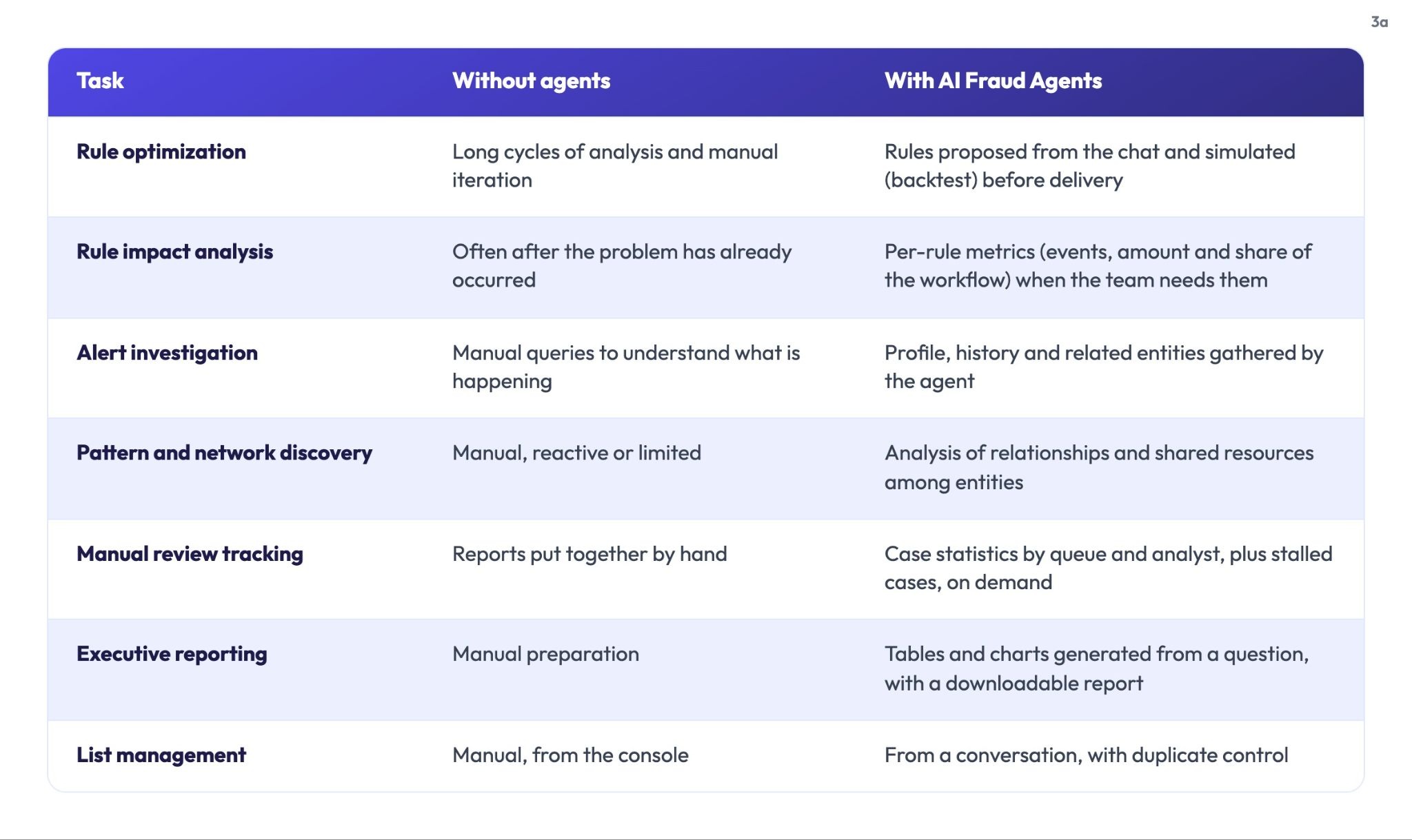
There is a structural reason behind this difference. In many operations, impact analysis works as a post-mortem. With agents, that analysis can be continuous and part of the team’s routine rather than a reaction to an incident.
What each AI Fraud Agent does
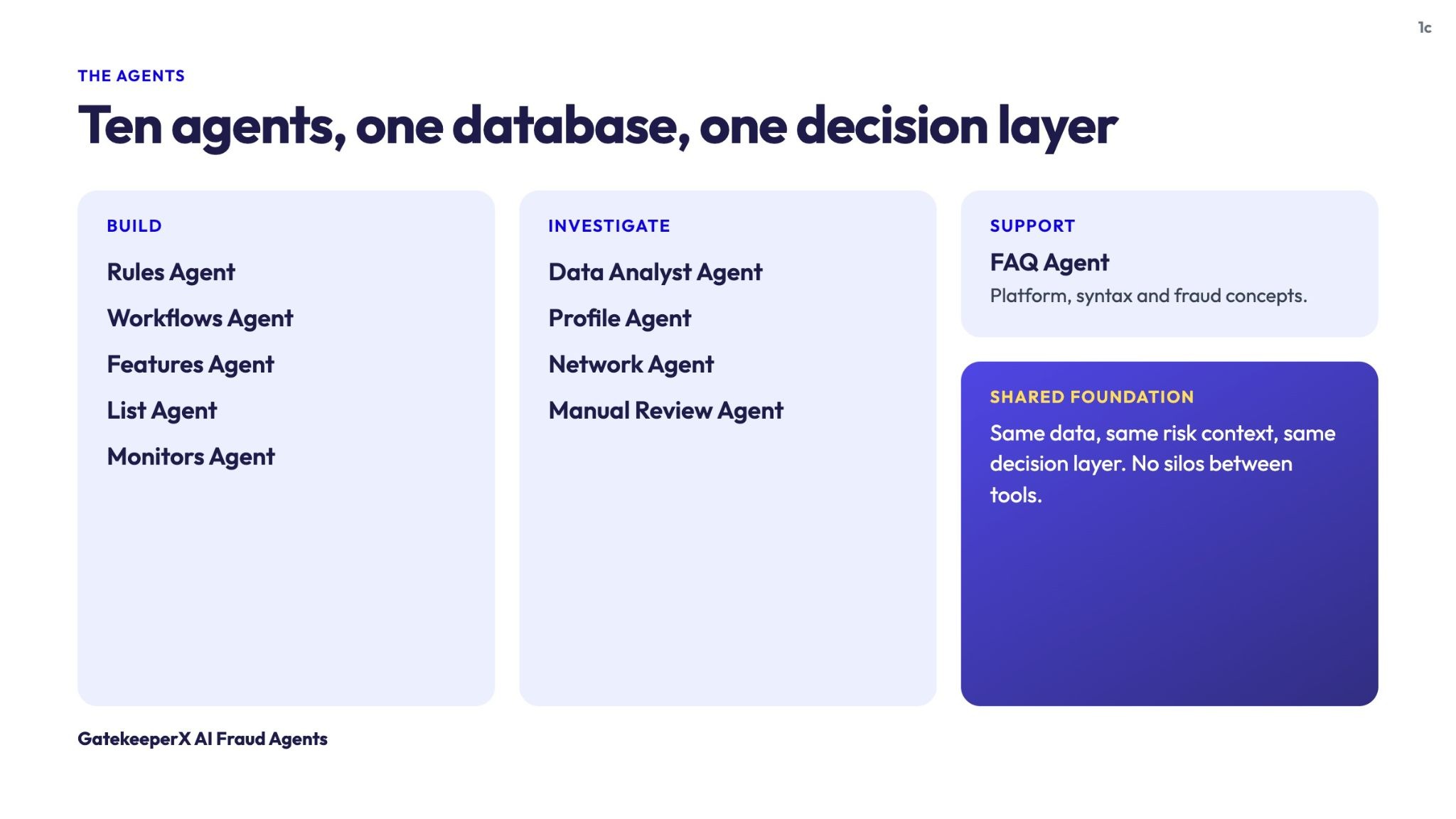
Each agent has a specific function, and all of them operate on the same database, the same risk context and the same decision layer. That shared foundation avoids silos between tools and inconsistent decisions.
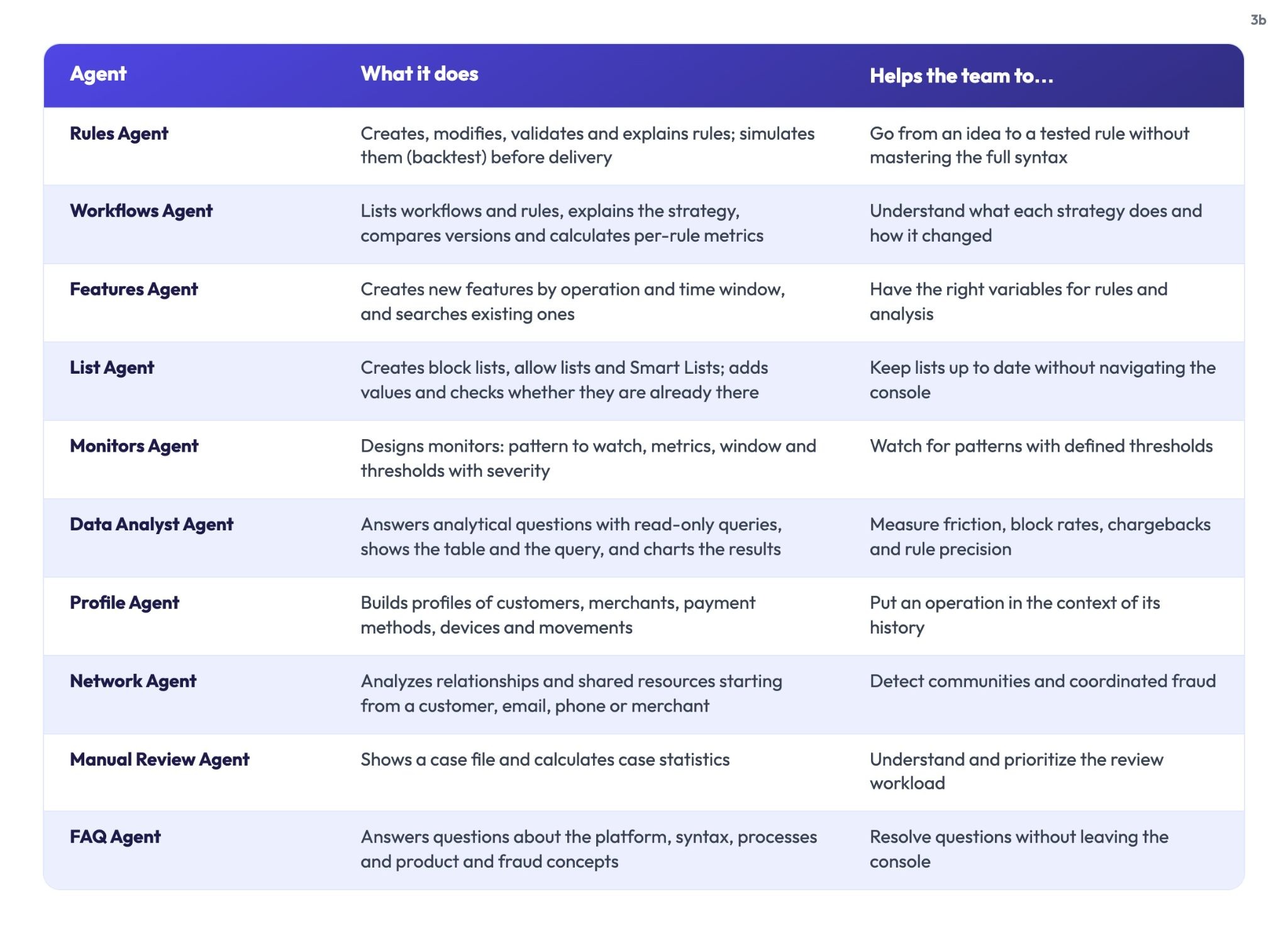
The agents can also summarize recent changes to features, lists and alerts pending review, and look up any entity by its identifier.
Two ways to work with agents
- Natural-language chat. Analysts interact with any agent from the console for everyday tasks: analyzing rule impact, exploring relationships among entities, reviewing cases or generating reports with data segmented to the business’s needs.
- Automatic alerts. Agents can run when an alert is generated to analyze the risk context, investigate related entities, classify the alert and suggest an action.
What value they create for the business
The value of agents is not in producing more information but in shortening the time between a question and a decision. That translates into four areas.
A team that spends more time deciding. When analysis, querying and reporting are handled in the conversation, analysts can focus on the cases and strategies where human judgment makes the difference.
Less friction for legitimate customers. Measuring which rules create the most friction and assessing their impact on the user experience makes it possible to adjust them with evidence, and to test the change before applying it. The goal is the right friction for the level of risk, not friction for everyone or for no one. This can help reduce false positives and improve approval of legitimate users.
Earlier, more contextual prevention. Investigating relationships and context from the moment of the alert aims to detect better, not just detect more.
A more governable operation. Because the agents operate on the same database and the same decision layer, rules are governed centrally and actions remain traceable. Analytical answers also show the full table, the query and the scope, which makes them verifiable and supports internal review.
The size of the impact depends on each operation: transaction volume, the state of current rules, the starting level of friction and the team’s maturity. That is why it is worth measuring with your own data rather than market averages.
Agents that augment the team, not replace it
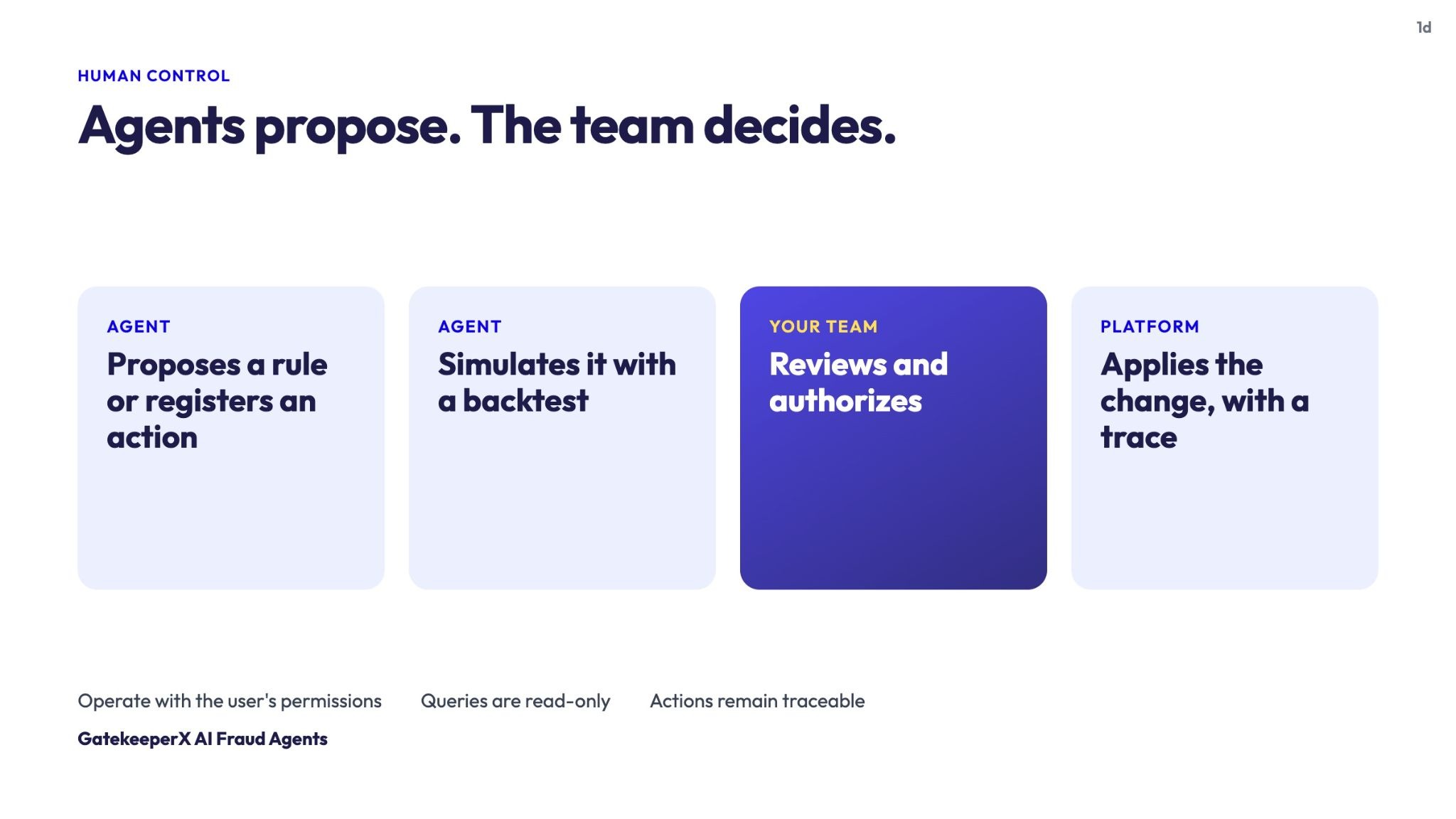
An agent can propose a rule, but the risk team decides whether it goes into production. AI Fraud Agents operate with the permissions of the user working with them, and critical actions or rule changes require human authorization. They also do not write directly from the chat: creating lists, features and monitors is registered as an action that is applied from the platform, and queries are read-only. Actions remain traceable.
That combination of agent speed and human judgment is what makes it possible to automate repetitive work without losing control over risk decisions.
Where to start
Teams evaluating agents commonly begin in one of three places:
- Rule optimization, with the Rules Agent and the Workflows Agent.
- Friction and false-positive reduction, using the Data Analyst Agent to measure which rules affect legitimate customers the most.
- Network fraud, with the Network Agent, to analyze relationships among entities.
Each one produces results the team can measure with its own operational data.
From analyzing to deciding
Conversations about artificial intelligence in fraud tend to focus on detecting more. The operational question is different: how long does it take a team to go from suspicion to decision? AI Fraud Agents work on that stretch: they put context, analysis and action within reach of a conversation, without taking control away from the team. It is a concrete way to decide better, not just block more.
Want to see how AI Fraud Agents work in your operation? Request a demo and talk to our team.
Frequently asked questions
-What is the difference between an AI Fraud Agent and a scoring model or a dashboard?
A scoring model estimates the risk of an operation and a dashboard shows metrics. An AI Fraud Agent takes part in the operation: it analyzes data, investigates context, answers questions in natural language and prepares actions in the platform, such as proposing a rule or registering the creation of a list.
-Do AI Fraud Agents replace fraud analysts?
No. They are designed to augment the team: they take on querying, analysis and preparation work so analysts can spend their time deciding. Critical actions require human authorization and remain traceable.
-Can agents change rules or lists on their own?
Not directly from the chat. The agent proposes the rule or registers the action of creating a list, a feature or a monitor, and the platform applies it. Rule changes require human authorization.
-How are agents used day to day?
In two ways. Through natural-language chat from the console, for example to analyze the impact of a rule or generate a report. Or by running automatically when an alert is generated, to analyze its context, investigate related entities and suggest an action.
-What information do the agents work with?
The same database, the same risk context and the same decision layer of the GatekeeperX system. This avoids information silos and lets answers rest on the operation’s actual data.


